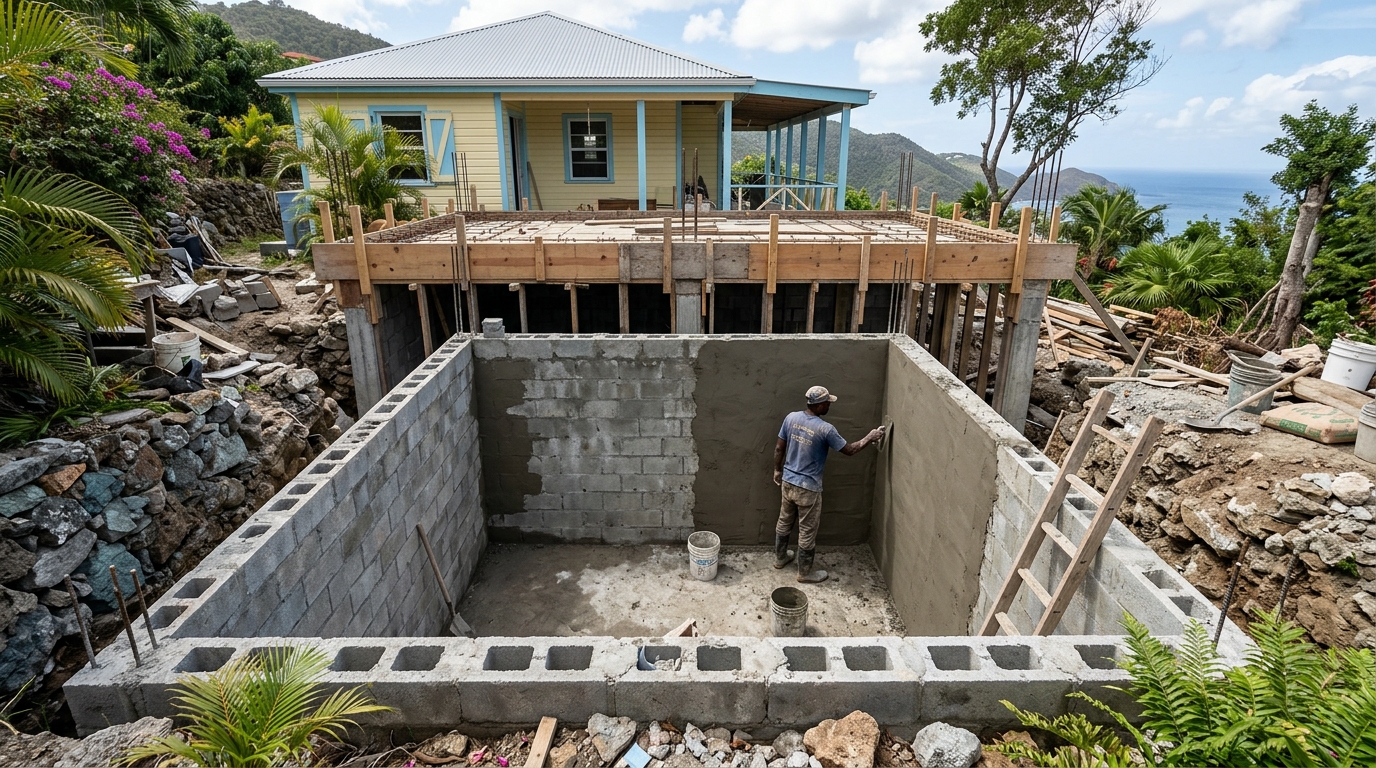
The Lifeline of the Virgin Islands: Master-Built Cistern Construction
More than survival infrastructure. It is the structural backbone and the ultimate water source for your home.
The Ultimate Water Source
In the USVI, where municipal water systems are often unreachable, your roof is your watershed. We design high-capacity cisterns that capture and store every drop of seasonal rainfall. Combined with advanced filtration, our master-built cisterns ensure your family remains self-sufficient through even the most prolonged Caribbean droughts.
The Foundation Support
In Caribbean architecture, a cistern is not just a tank—it is the structural base of the entire home. It carries the weight of the structure and anchors it against hurricane-force winds. Our engineering ensures these monolithic concrete structures provide the seismic stability and load distribution required for the rugged Island terrain.
Water Is Life.
The Rock Makes It Hard.
Building a cistern in the USVI is nothing like building one on the mainland. The ground is not soil. It is Blue Bitch — one of the hardest rock formations in the hemisphere.
Excavating a cistern here means drilling and cutting through solid rock before a single drop of concrete is poured. That excavation alone can take days or weeks. Then comes the sealing. The same rock that resists the dig also resists water infiltration — but only if the cistern walls are sealed correctly against it.
A gap between the concrete and the rock face is a slow leak waiting to destroy your investment. Mark has built cisterns in this terrain for 27 years. He knows how to cut the rock, seal against it, and build a cistern that holds every drop it is meant to hold.

Water Is the Difference Between Surviving and Suffering.
When Hurricane Maria tore through the Caribbean in 2017, Puerto Rico and the U.S. Virgin Islands were both devastated. But what happened in the weeks that followed told two completely different stories.
In Puerto Rico, most residents went without running water for months. The bottled water that was shipped to help sat locked in a warehouse at the airport — undelivered, unused — while families went without. The infrastructure collapse was so complete that basic survival became a daily crisis.
In the Virgin Islands, the story was different. Yes, there was structural damage. Yes, roofs were torn off and power lines went down. But most VI homes had cisterns. And because of that, families had water to drink, cook, bathe, and clean within days. Not months. Days. Life returned to something resembling normal while the rest of the Caribbean was still in crisis.
That is what a cistern means in the Virgin Islands. It is not a feature. It is not an upgrade. It is the single most important structure on your property. When everything else fails — and in a Category 5 storm, everything does fail — your cistern is what keeps your family alive.
"In 2017, the cistern was not a convenience. It was the difference between crisis and recovery."
— Mark Vitalis
Zoning, Compliance &
Extreme Resilience
Every square foot of roof in the USVI is mandated by DPNR (Department of Planning and Natural Resources) to provide at least 10 gallons of cistern storage. But meeting the minimum code is not the same as building for survival.
When Hurricane Maria hit in 2017, it didn't just test roofs; it tested the resilience of island infrastructure. Homes with improperly built cisterns faced structural shifts and water contamination. We build beyond the minimum code, ensuring your cistern acts as a massive ballast that keeps your home anchored when the winds exceed 150mph.
Critical Survival Standards
- verifiedMonolithic pour strategies to eliminate cold joints
- verifiedMulti-layer hydraulic cement sealing systems
- verifiedSeismic anchoring into Blue Bitch bedrock
- verifiedHurricane-rated ballast engineering
Cistern Capacity Calculator
DPNR requires a minimum of 10 gallons of cistern storage for every square foot of your roof. Use this calculator to find out what your property needs — before you build.
DPNR minimum (gallons)
0.00
Cistern size needed (cubic feet)
0.00
Calculated per USVI Title 29
building code standards
Proven in the Islands
Luxury West Indian estates where our cisterns provide the invisible but vital structural foundation.

St. Thomas Estate

St. John Oceanfront

Christiansted Custom
Expert Guidance
What is the USVI cistern requirement for new construction?
DPNR mandates a minimum of 10 gallons of cistern capacity per square foot of roof area. This is a survival standard designed to ensure primary water independence for all Virgin Islands residents.
How long does it take to excavate a cistern on St. Croix or St. John?
Excavation depends entirely on the terrain. In 'Blue Bitch' heavy rock zones, a standard residential cistern can take 7-14 days of specialized hydraulic hammering before the foundation can be formed.
Why is monolithic pouring important for cisterns?
A monolithic pour eliminates 'cold joints'—the seams between different concrete batches where leaks typically form. By pouring the floor and walls in a continuous process, we create a single, leak-proof structural vessel.
Secure Your Foundation
Request a professional assessment for your next cistern infrastructure project.